Working alongside Leitat, Cromogenia is bringing a laboratory-developed chemical recycling process for polyurethane-coated textile waste closer to industrial application, while exploring new opportunities for the valorisation of recovered materials in polyurethane formulations.
The transition towards a circular economy requires not only innovative recycling technologies but also the ability to transfer these processes from laboratory development to industrial application.
Within the European SOLSTICE project, Cromogenia is working in close collaboration with Leitat to address this challenge, contributing its expertise in polyurethane chemistry and industrial process development.
From laboratory development to industrial scale-up
Leitat has developed a chemical recycling process at laboratory scale, designed to recover valuable materials from polyurethane-coated textile waste.
Building on this technological development, Cromogenia is responsible for the industrial scale-up of the process, working to transfer the technology towards larger-scale operations at its facilities.
As part of this collaboration, the Leitat team recently visited Cromogenia to support and follow up on the scale-up activities. This technical exchange represents an important milestone in the collaboration, bringing together Leitat’s expertise in process development and Cromogenia’s industrial capabilities.
The initial scale-up activities have focused on pre-consumer polyurethane-coated textile waste supplied by VELAMEN. The next challenge is to extend the process validation to post-consumer textile waste, further exploring the potential of this recycling technology.
Giving recovered materials a new life in polyurethane applications
Beyond the recycling process itself, the valorisation of recovered materials is another central objective of SOLSTICE.
Cromogenia applies its expertise in polyurethane chemistry to explore the incorporation of these recycled materials into new polyurethane formulations, opening up opportunities for their use in new applications.
In parallel, Indresmat is investigating their use in the development of new polyurethane foams.
These complementary approaches demonstrate how chemical recycling can transform complex textile waste streams into valuable resources for different applications within the polyurethane industry.
Collaboration driving industrial circularity
The collaboration betwee n Leitat, Cromogenia and Indresmat brings together complementary expertise in chemical recycling, industrial scale-up and polyurethane material development.
Through SOLSTICE, Cromogenia contributes to bridging the gap between laboratory research and industrial application, helping advance chemical recycling technologies and promote the incorporation of recycled materials into new polyurethane solutions.
This work supports the development of more circular approaches to polyurethane production and the more efficient use of resources.
About SOLSTICE
SOLSTICE is a European project funded by the Horizon Europe programme, bringing together partners across the textile and plastics value chains to develop innovative solutions for textile waste prevention, reuse and recycling.
The project aims to accelerate the transition towards more circular textile value chains through technological innovation and industrial collaboration.
SOLSTICE has received funding from the European Union’s Horizon Europe research and innovation programme under Grant Agreement No. 101134989.
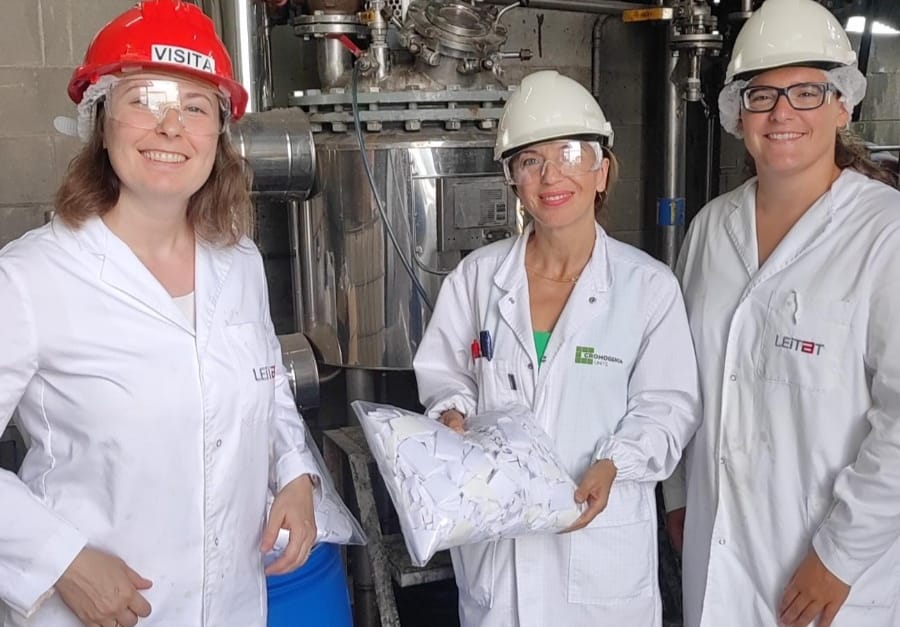
Leitat and Cromogenia teams during a technical visit to Cromogenia’s facilities as part of the industrial scale-up activities within the SOLSTICE project.